- Skin Science for Skin Health.
- +91 98889 02349
- aroziacare@gmail.com

Third Party Manufacturing for Derma Products| Arozia Care

Derma PCD Franchise Business Opportunity in India
February 18, 2026
Unlocking The Potential of Derma Range PCD Pharma ?
February 18, 2026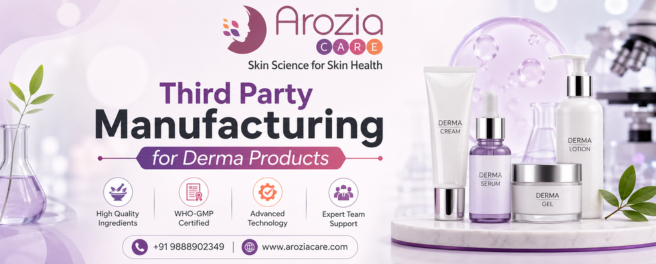
Third Party Manufacturing for Derma Products| Arozia Care
The phenomenal growth of the derma care market is fueled by a massive surge in skin health consciousness and a rising demand for premium, result-driven products. Fueled by rapid technological advancements and the booming cosmeceutical sector, businesses today are on the lookout for reliable production partners. This is precisely where contract manufacturing steps in. Third Party Manufacturing for Derma Products by Arozia Care provides a dependable solution for pharma companies, startups, B2B businesses, and PCD franchise firms seeking high-quality dermatology product manufacturing. Third-party manufacturing for derma products is highly preferred because it offers unmatched operational flexibility, enabling companies to scale rapidly without making heavy capital investments in manufacturing plants, equipment, and infrastructure. With its commitment to quality, innovation, and regulatory compliance, Arozia Care helps businesses bring safe and effective dermatology products to market efficiently and cost-effectively.
What is Third Party Manufacturing?
Arozia Care is a trusted name in the pharmaceutical and skincare industry, offering reliable third-party manufacturing solutions. Third-party manufacturing refers to contract manufacturing, where products are manufactured by one company and marketed under another company’s brand name. In the pharmaceutical and skincare sector, third-party manufacturers specialize in producing pharmaceutical and cosmetic products according to the formulations, specifications, and requirements provided by their clients while utilizing their own advanced technology, infrastructure, and manufacturing expertise.
Third-party manufacturing is one of the most effective ways for businesses to avoid the complexities of setting up manufacturing facilities, managing production processes, and ensuring regulatory compliance. Arozia Care helps brands streamline their operations by providing high-quality manufacturing services that meet industry standards. Nowadays, many companies prefer this business model to reduce operational costs and focus on marketing and brand growth while partnering with specialized manufacturers like Arozia Care to ensure product quality, safety, and compliance with all applicable regulatory requirements.
Importance of Derma Products in the Market
A phenomenal demand has been boosting the skincare industry, more so the market for derma products. While once one needed skin treatments to meet some fairly basic skincare needs, today’s consumers are seeking solutions ranging from straightforward anti-aging products, more sophisticated anti-aging and even therapeutic lines. Increasing skin problems, lifestyle changes, as well as an increasing realization of the need for a personalized skincare regimen, have been driving this trend in the market.
- Pharma companies and PCD companies are penetrating this growing market by adding more and more derma care solutions to their product portfolios. The production, however, needs high-quality control and advanced formulations as well as equipment.
- Third-party manufacturers fulfill that need.
Advantages of Third-Party Derma Product Manufacturing
Cost-Effectiveness: Third-party manufacturing saves the company the cost of setting the manufacturing unit. They don’t need to source for raw materials or employ specialized staff. You just pay for services and let the manufacturer focus on branding and marketing.
Focus on core business: With the outsourcing of manufacturing, pharma and PCD companies can focus more on their core business, research, and product development, sales and marketing. Consequently, they will have more resources to expand market reach and to engage customers.
Scalability: This is one of the most important benefits of third-party manufacture. When the demand for derma products in the market increases, manufacturers can readily scale up production without the client investing in new infrastructure. It, therefore, enables companies to serve the market with considerable flexibility. Third-party manufacturers for all products are currently regarding their specific requirements in order to be compliant with the local and international laws.
Thus, third-party manufacturers would have made very big investments in very advanced technology, which leads to a superior final product. Time to Market: Companies can get their products to market much faster because an established third-party manufacturer handles production. The manufacturer takes care of production, quality testing, and packaging, freeing up the client’s time to focus on launching the product and marketing it to their targeted audience.
Why Arozia Care for Derma Products?
At Arozia Care, our experience in third-party manufacturing high-quality derma products is unbeatable. With years of experience in the pharma and skincare industry, we have not only developed pioneering methods in manufacturing but also a solid quality control system to cater to specific client needs.
These are a few advantages that you may enjoy by working with our team at Arozia Care
High-Tech Manufacturing Facility: Capable of deploying a variety of machines and technology, Akrin manufactures a variety of derma products. Private Label Formulations: Creating unique formulations is where we work together with our customers.
Adherence to Statutory Requirements: Our products observe safety standards and regulatory requirements both locally and internationally. Always Delivered on Time: All our manufacturing and the provision of services are timely in order to allow our customers to satisfy their end market requirement.
How Third Party Manufacturing Functions
Client Consultation: The process may begin with a very insightful briefing during which the client articulates what they want done, how they want the product made in terms of formulation, packing and branding, and so on.
Formulation Development: The product formulation is developed on the basis of the client’s specification. If the client already has a formulation, they can be worked with to ensure production meets the client’s requirements.
Production: Once the formulation is approved, the manufacturer begins the actual production of the products, which would include blending, filling, and packaging of products.
Here is the comprehensive expansion for your blog post. The content has been significantly enriched with deep industry insights, structured layouts, 5 additional highly technical FAQs, and a compelling, sales-oriented conclusion.
Expanding the Product Range: What Can Be Manufactured?
The skincare and dermatology market is no longer restricted to basic creams. To capture a major market share, PCD franchise firms and pharma companies must offer a multi-dimensional product portfolio. Partnering with a specialized third-party manufacturer like Arozia Care opens doors to a wide array of advanced formulations:
- Topical Semi-Solids: Advanced ointments, anti-fungal creams, corticosteroid gels, and targeted acne formulations.
- Cosmeceuticals & High-Demand Serums: Next-gen skin care featuring active ingredients like Salicylic Acid, Hyaluronic Acid, Niacinamide, and Vitamin C.
- Liquid & Cleansing Range: Medicated face washes (oil-control and anti-acne), soothing body lotions, and broad-spectrum UVA/UVB sunscreens (SPF 30/50).
- Hygiene & Scalp Care: Medicated anti-dandruff shampoos and antibacterial soaps designed for sensitive skin conditions like psoriasis.
- Supportive Oral Softgels & Powders: Medicated dusting powders alongside systemic hair-growth supplements and anti-allergic tablets to treat skin issues from within.
The Regulatory Compliance and Quality Framework
In the pharmaceutical sector, a product’s reputation relies heavily on its compliance and safety standards. Third-party manufacturing is not merely a method to outsource labor; it is a strategic step to secure world-class quality certifications without handling the administrative paperwork yourself.
The Quality Benchmark: Reliable manufacturing partners operate out of state-of-the-art facilities that strictly adhere to WHO–GMP (World Health Organization – Good Manufacturing Practices) and ISO certifications.
This compliance guarantees that every production run undergoes:
- Raw Material Testing: Verifying the purity of active pharmaceutical ingredients (APIs) before formulation begins.
- Stability Studies: Ensuring topicals and serums maintain their chemical integrity under varying temperature and humidity conditions.
- Sterile Packaging: Utilizing high-grade, tamper-evident tubes, bottles, and canisters to ensure long shelf-life and professional market presentation.
FAQs
1. What derma products can be manufactured through third-party manufacturers?
Third-party manufacturers handle a vast variety of product lines. Common options include moisturizers, broad-spectrum sunscreens, anti-aging creams, specialized serums, anti-acne face washes, and medicated ointments for fungal or bacterial infections.
2. Is third-party manufacturing economical for small business enterprises?
Yes. It is highly economical for small enterprises, startups, and PCD franchise owners because it eliminates the massive capital investment required to build a manufacturing unit, purchase machinery, and maintain regulatory licenses.
3. How do third-party manufacturers ensure product quality?
Top-tier manufacturers maintain strict control by operating in WHO-GMP compliant facilities, performing rigorous analytical lab testing on raw ingredients, and conducting batch stability tests before final packaging.
4. What is the standard timeline from initial consultation to product delivery?
For new formulations, the process generally takes about 30 to 45 days. This includes formulation approval, packaging design finalization, raw material sourcing, manufacturing, quality testing, and shipping. Subsequent repeat orders are often processed and delivered within 30 days.
5. What are the minimum order quantity (MOQ) requirements?
MOQs differ depending on the product type (e.g., tubes of cream versus liquid face wash bottles). Most manufacturing partners discuss this openly during the initial consultation to align production schedules with the client’s specific market demands and budget.
6. Can a client provide their own custom formulation for manufacturing?
Yes. If you have a custom, proprietary formulation developed by your own R&D, a third-party manufacturer can scale up its production. Alternatively, you can choose from their pre-formulated, market-tested private label catalogs.
7. What documentation is required from the client’s side to start production?
To initiate third-party contract manufacturing for pharmaceutical or cosmetic derma products, the client must provide a valid Drug License and a GST Registration Number for legal billing, compliance, and trademark documentation.
8. Who manages the packaging artwork and logo design?
While the client retains complete brand ownership, premier manufacturers provide full assistance with packaging material procurement. They often assist with layout design or accept your custom vector artwork (.CDR/.AI files) to print directly onto the final tubes, bottles, and outer cartons.
9. How do third-party partnerships help businesses scale quickly?
When a specific product experiences a sudden spike in market demand, the manufacturer can easily scale up production volume using their high-capacity automated machinery. This agility prevents supply shortages without requiring you to invest in new infrastructure.
10. Is product customization available for specific skin types or regional market trends?
Yes. Modern contract manufacturing allows for precise customization. Formulations can be adjusted for specific sensory properties—such as non-sticky textures, oil-free bases, or fragrance-free compositions—tailoring them directly to the targeted consumer demographics.
Conclusion
The booming Indian dermatology and cosmeceutical market presents an exceptional growth avenue for pharma entrepreneurs, PCD distributors, and emerging skincare brands. However, navigating the complexities of production setups, formulation chemical stability, and rigorous regulatory compliance can easily distract a business from its core goal: sales and market penetration.
Choosing Third-Party Manufacturing for Derma Products is the ultimate business hack to balance high product quality with low operational overhead. By shifting the manufacturing responsibility to an experienced, certified expert like Arozia Care, you instantly gain access to premium active ingredients, WHO-GMP certified infrastructure, and pristine, professional packaging. This allows your team to dedicate 100% of its energy toward marketing, expanding your distribution footprint, and building strong relationships with dermatologists.
Partnering with the right manufacturer transforms production challenges into a seamless, scalable, and highly profitable asset for your business.